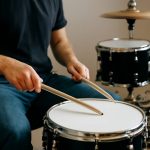
Stephen Flinn is an active composer, performer, and improviser living in Berlin, Germany. From intimate black-box theaters to reverberant galleries, he performs throughout Europe, Japan, and the United States in settings ranging from solo to large ensembles, supporting Butoh dancers, and anchoring various ongoing projects. His work is grounded in decades of exploring the drum, cymbal, and resonant object not only as instruments, but as raw materials for sound design, texture, and narrative.
Through persistent exploration of traditional percussion, he has forged distinct sounds and phonic textures, cultivating new extended techniques to express ideas in diverse musical situations. This process positions him within a lineage of artists who expand instrumental vocabularies while honoring their acoustic core. The result is a practice that treats rhythm as only one dimension among many—timbral grain, spatial decay, and gesture become equal partners in communication.
Seen through this lens, terms like Experimental Percussion and Avant Garde Percussion describe more than genre: they signal a method of listening, an ethics of collaboration, and a commitment to risk. As an Avant Garde Percussionist based in a city renowned for exploratory music, Stephen’s performances continually reshape how audiences hear wood, metal, skin, and the space in which they vibrate.
From Drum to Sound Sculpture: Techniques that Transform Materials into Music
At the core of this practice lies a devotion to the physical realities of percussion. A drumhead is not only a membrane for pulse; it is a canvas for friction, pressure, scraping, and breath. Over years of experimentation, Stephen has found ways to extract complexity from seemingly simple objects. Brushes, mallets, and sticks become extensions of the hand, and the hand itself becomes a sensitive tool capable of coaxing microtonal whispers, dry textures, and sudden flashes of resonance. By varying touch, angle, and pressure, ordinary surfaces yield extraordinary detail, adding emotional vocabulary beyond conventional strikes and rolls.
Extended techniques foster this expansion. Bowed cymbals generate long arcs of tone; coins and chains laid across drumheads introduce unstable partials; wooden blocks and stones provide brittle transients that cut through dense ensembles. The familiar click of a rimshot is reframed as a sculptural event when juxtaposed with sanded heads or muted metals. Subtle dampening refines overtones until the sound resembles voice or wind, achieving the phonic textures that define Stephen’s approach. This is not an abandonment of tradition so much as a deep reading of it. The same instruments that serve orchestral clarity can, under different hands, reveal ghosted harmonics and tactile noise.
Space functions as an instrument in its own right. The decay of a cymbal swell in a cathedral-like room suggests pacing; the immediate dryness of a studio favors granularity. A keen sense of acoustics informs decisions in real time, particularly in improvisation. Silence becomes lever and counterweight—pauses invite listeners to inhabit the tail of a sound, to notice how energy travels from object to air. In this way, Experimental Percussion is less about novelty and more about heightened attention to cause and effect, material and motion.
Crucially, Stephen’s vocabulary remains rooted in the physical bodies of traditional instruments. Rather than chasing exotic gear for its own sake, he seeks new angles on the familiar: the way a floor tom speaks when pressed, the different resonances a cymbal reveals at edge versus bell, the evolving grain of a snare brushed in minute circles. These micro-choices accumulate into a language where color, texture, and weight form phrases as articulate as any melodic line.
Improvisation and Collaboration: Solo Intensity, Butoh Synergy, and Ensemble Dialogue
Improvisation threads through every facet of performance. In a solo context, it offers radical clarity: gesture equals meaning. A single roll can unfurl a narrative if shaped with sensitivity to density, speed, and decay. Stephen’s solos often operate like site-specific installations, with each sonic choice responding to the room, the audience’s breath, and the latent resonance of objects at hand. The goal is not virtuosity for its own sake, but intention—using dynamic range and microtiming to open a horizon of associations for the listener.
Collaboration multiplies that horizon. In large groups, the percussionist’s role can shift from timekeeper to colorist, from engine to atmosphere. A brittle wood click may serve as a quiet cue that redirects the ensemble; a low drum moan can unify scattered textures. Interaction becomes a conversation in which silence, anticipation, and restraint matter as much as volume. Within these frameworks, Stephen adapts his extended techniques to complement strings, winds, electronics, or voices, ensuring that each gesture nourishes the collective shape rather than competing for space.
Collaboration with Butoh dancers intensifies the dialogue between sound and motion. Butoh’s aesthetic, often grounded in slowness, transformation, and bodily metaphor, invites percussion that breathes with the body. A hushed cymbal bow articulates the dancer’s inner tremor; a pulse of hand-drum pressure mirrors a shifting center of gravity. Rather than scoring movement from the outside, the percussion becomes kinesthetic—alive to weight, balance, and the emotional arc onstage. This attentiveness to physical presence aligns with the improviser’s craft: listening through the eyes, interpreting through touch, allowing each sonic event to be guided by movement’s intention.
Across Europe, Japan, and the United States, these interactions unfold under diverse cultural and acoustic conditions. A quiet Kyoto hall may magnify the rustle of a brush stroke, inviting minimalism; a New York loft’s hard reflections may reward percussive bursts that cut brightly. Berlin’s exploratory scene nurtures risk-taking dialogs, while festival contexts provide platforms for large-scale, multi-artist structures. Through it all, the core remains the same: Avant Garde Percussion as a living practice of listening, responding, and reshaping the experiential field shared by performer and audience.
Real-World Examples: Sessions, Ensembles, and How Audiences Hear Percussion Differently
Consider a solo performance in a reverberant Berlin gallery. The set begins with silence long enough for the room to announce its size. A single brushed stroke across the snarehead folds into the room’s tail, establishing a conversation with the space. The next event is a bowed cymbal, a thread of tone that hovers just above audibility. Each addition—soft mallet on floor tom, a coin skittering across a wooden block—introduces contrast, not volume. Listeners start to register time by decay length and spectral shift rather than by tempo. Over twenty minutes, the palette evolves from whisper to grain to a fleeting, full-bodied crescendo. The takeaway is not spectacle but sensitivity: the room itself becomes part of the band.
Now imagine a large ensemble in a European festival hall. Multiple improvisers navigate layers of texture; the percussion is both anchor and solvent. A low drum resonance cues a collective diminuendo; tight stick clicks align disparate lines into transient rhythms before dissolving back into color. The percussionist’s task is curatorial—selecting sounds that clarify form without dominating. A rusted metal plate introduces a harsh brightness that reframes warm strings; a dampened tom provides body without overt pulse. This is where decades of experimentation with traditional instruments matter: knowing how to summon a specific overtone, how to mute a ring just enough to let a clarinet’s microtonal inflection breathe.
In a collaboration with Butoh dancers in Japan, the arc unfolds at the body’s tempo. A dancer’s slow rotation prompts a coaxed roll at the drum’s edge, the stick barely touching the head to produce a trembling, breath-like murmur. Feet sliding across the stage trigger sand-on-skin textures that mirror friction and weight shift. When the choreography gathers force, the percussion answers not with sheer loudness but with layered attacks—short wood taps under a broader cymbal swell, the blend forming a kinetic aura rather than a rigid beat. Audience focus migrates from counting to feeling, from discrete events to the emergent image of motion and sound as one organism.
Another example comes from a small U.S. venue where the dry acoustics encourage clarity. Here, the set highlights the articulation of different implements: felt mallets for warmth, rods for splintered edges, fingertips for intimate, vocal inflections. A sequence might pair a barely-there snare scrape with a bright, bell-like strike on cymbal edge, followed by a palm-muted tom that breathes like a low voice. Without relying on electronics or looping, form emerges through contrast and memory. Audiences accustomed to backbeat-centric percussion discover a narrative built from texture, weight, and spatial relation.
What unites these scenarios is a principle of attunement. The improviser listens to the instrument as if for the first time, responds to collaborators with humility, and trusts that resonance—down to the finest overtone—can carry meaning. This is the sensibility that places Stephen within the ongoing evolution of Experimental Percussion. The drumkit becomes a theater of micro-gesture; cymbals turn into singing metal; blocks, shells, and bells act as characters whose voices change with context. Technique serves expression, and expression serves the shared moment between performer and audience.
For those exploring similar paths, practice might focus as much on touch as on speed: learning how little force is needed to elicit a whisper, how to shape decay with pressure instead of dampening, how to orchestrate a set from noise-floor to bloom. Listening exercises—attending to the hum of a room, the grain of a stick on metal, the breath between gestures—sharpen the ear. Collaboration becomes research, with each project offering new data about interaction and space. In this way, the work remains perpetually unfinished, which is precisely its vitality. The vocabulary expands, the sensitivity deepens, and the promise of discovery keeps drawing listeners into the world that Stephen Flinn continues to reveal project by project.